Here is the cover of my latest book, this time a novel of historical fiction. It traces the life of Abram from his birth in Ur in the land of Akkad at the end of the 18th century BCE to his decision to sacrifice his son, Isaac.
I anticipate publication late this spring (2026).
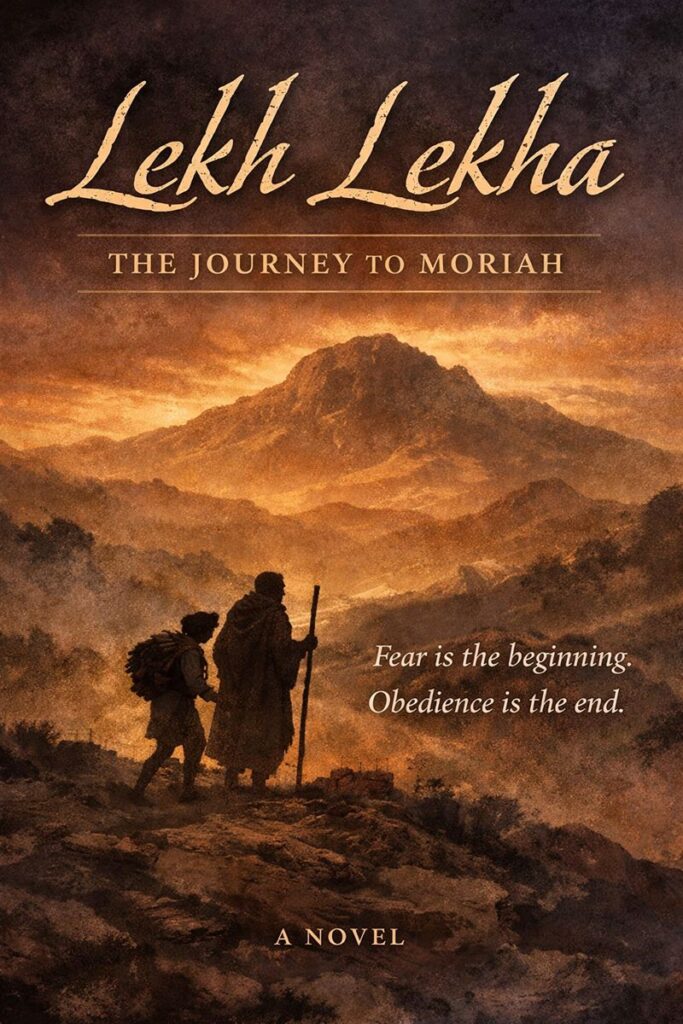
Book cover
Lekh Lekha (Go For Yourself)
In Genesis 12:1, YHWH says to Abram, Lekh Lekha (לֶךְ־לְךָ), literally “go-for-yourself.” One way to interpret this phrase (and I do) is to understand that it is not a directive to go to a particular destination. For example, it does not mean something like “go to Detroit.”
Its literal translation is more meaningful. In the biblical text below, pay attention to the emphasized word:
“לֶךְ־לְךָ… אֶל־הָאָרֶץ אֲשֶׁר אַרְאֶךָּ“
“Go for yourself …to the land I will show you.”
The bolded phrase, אַרְאֶךָּ (“I will show you”), is a verbal phrase expressing causation and is understood that YHWH will cause or enable Abram to discern the land to which he is to go. In other words, Abram is not handed a map., nor given a destination. He is afflicted with wanderlust and must discern where YHWH wishes him to go (or what he must do) based on the signs, events, or inner convictions that unfold during his journey. Paraphrased, Genesis 12:1 might be better understood as
Go discern for yourself by My signs, if you can, the land you will one day own.
In this novel, the overall arc of Abu’ram’s story is directed toward becoming a certain kind of person—one who struggles to discern what God will one day reveal and what he will one day become.
Lekh Lekha is a book of historical fiction (think of James Michener’s Hawaii or The Red Tent by Anita Diamant). The story of Abraham’s journey from Ur in ancient Akkad to the land of Moriah is rightly seen as a tale of a man, originally a pagan Akkadian, coming to believe in a monotheistic God. But, there is so much, much more.
This novel takes his spiritual journey seriously. It does not treat Abraham as a flat symbol of obedience, but as a man walking in the face of uncertainty and hard moral choices. At the climax of his journey, he is presented with a terrible, Hobbesian dilemma: prove his faith by murdering his son, or prove it by refusing God’s own request. What kind of faith survives such a test? What kind of God asks it? Lekh Lekha explores not only Abraham’s obedience, but the cost of that obedience—on his family, on his own soul, and on the future promised to him. It is the story of a man becoming righteous not through clarity, but through discernment and in the end discovers fear; a fear whose significance echoes beyond Moriah.
Now, Go and Study